
Turn Expert Process Into
Repeatable Spectral Workflows.
Clarity AI workflows capture how your team actually evaluates data: your procedures, your quality standards, and your decision criteria. The result is a technology layer that helps teams ask, analyze, review, and iterate with more consistency.
See what Clarity AI can help you ask for
These demos show concrete requests turning into structured, inspectable hyperspectral work.
“Find copper in Yerington”
Clarity AI can turn mineral exploration goals into alteration mapping, target ranking, confidence review, and evidence that geologists can inspect.
Open on YouTube“Label my image”
A workflow can guide labeling, class definitions, confidence checks, and review so labels become reusable training evidence instead of one-off annotations.
Open on YouTube“Train and optimize a model”
Teams can preserve training choices, validation logic, and model-performance review so future experiments start from known decisions.
Open on YouTubeClarity turns analyst requests into structured spectral workflows, including indices, thresholds, classification steps, and review logic.
Each run surfaces the spectral features, decision path, and confidence context behind the output so teams can inspect and defend what happened.
Workflows preserve procedures, quality standards, and decision criteria so the next analyst starts from the team's best known approach, not a blank prompt.
What Clarity AI does with a technical request
Tell Clarity what you need to evaluate. It helps structure the analysis, run the relevant spectral steps, and explain the evidence behind each output so your team can review and refine the result.
Translate a Request
Turn questions into structured spectral workflows with the relevant indices, thresholds, classifiers, and review steps.
Apply Quality Checks
Add masking, artifact checks, sensor context, and failure conditions before the result is treated as decision-ready.
Explain the Path
Show the spectral features, thresholds, confidence context, and reasoning used to produce each map or report.
Tune Models
Help teams iterate on labeling, model training, validation, and parameter choices inside a repeatable process.
Review and Rerun
Let analysts inspect steps, adjust assumptions, rerun the workflow, and keep the parts that performed well.
Export the Evidence
Produce maps, spectra, confidence layers, and reports that can move into customer review and downstream tools.
A workflow teaches Clarity how your team works.
Instead of treating every request as a generic prompt, workflows give the system operating context: what success looks like, what quality checks matter, and which rules should govern the output.
When someone asks Clarity to analyze a scene, review a classification, or run an experiment, the right workflow can be applied automatically so the output reflects team standards from day one.
That makes the technology more than a chat layer. It becomes a reusable execution model for hyperspectral analysis, review, and reporting.
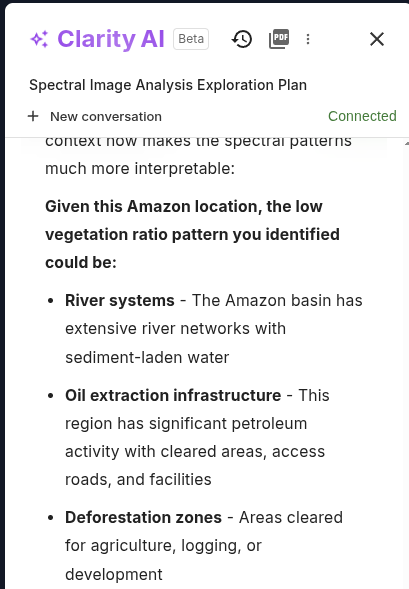
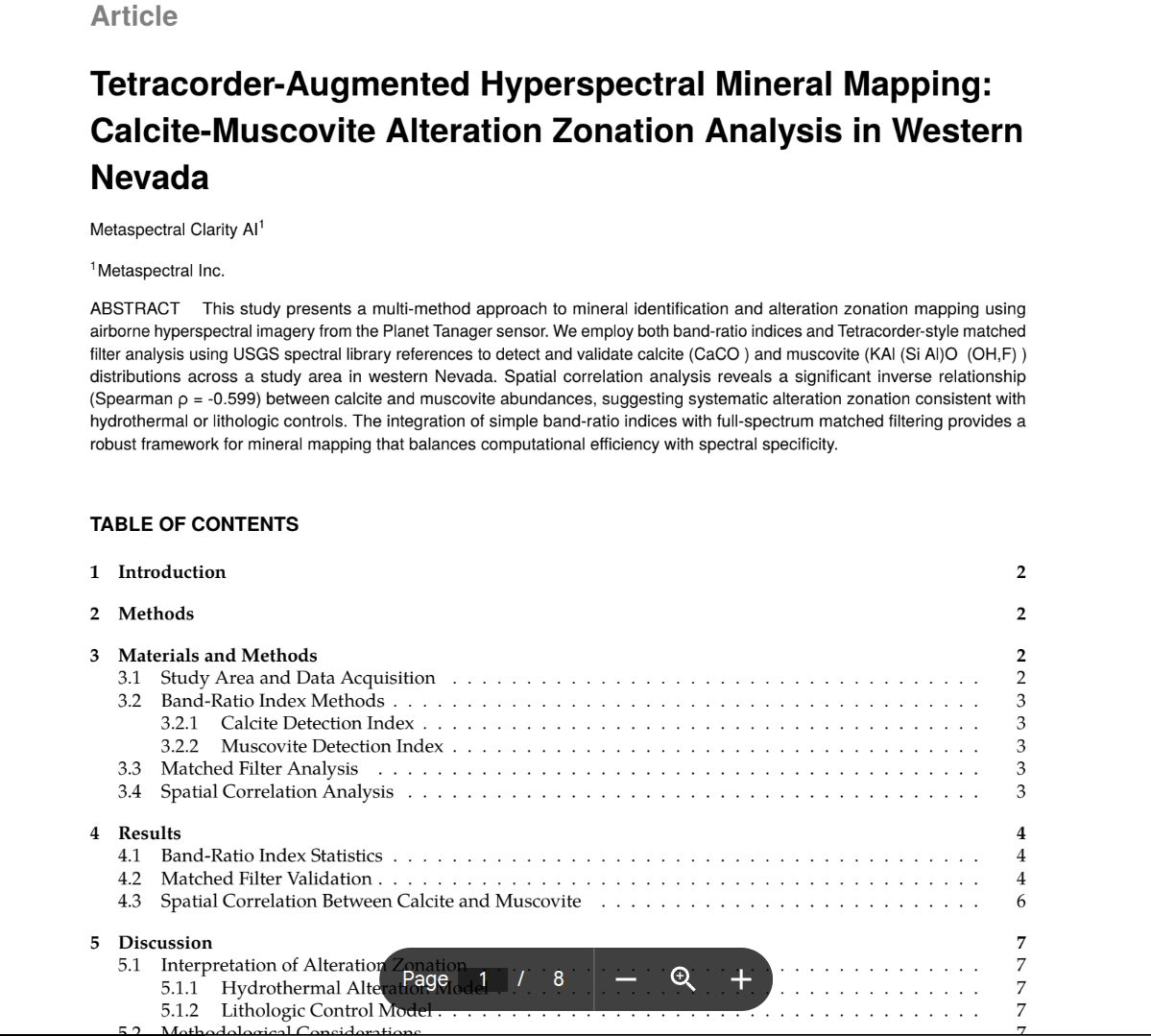
Why workflow-based AI behaves differently
Your Decision Logic
Workflows capture the conditional reasoning experts use in practice, including how to interpret edge cases before they become expensive mistakes.
Failure Patterns and Guardrails
They store the negative knowledge teams usually keep in heads and notebooks: false positives to watch for, masking rules, and when not to trust an output.
Context Boundaries
A workflow can encode where it applies, so SWIR mineral logic is not reused blindly on the wrong sensor, region, or mission objective.
Workflows compound into institutional knowledge
The value is not just one automated run. It is the way workflows preserve, refine, and connect expertise across teams over time.
Research, QC, masking, model tuning, and reporting can be linked as reusable workflow components instead of isolated one-off analyses.
Where teams use workflows today
The pattern stays the same even when the mission changes: capture process, apply it consistently, and keep improving it with new evidence.
Encode alteration mapping, target screening, and ranking logic so new scenes and assays improve the workflow instead of resetting the process.
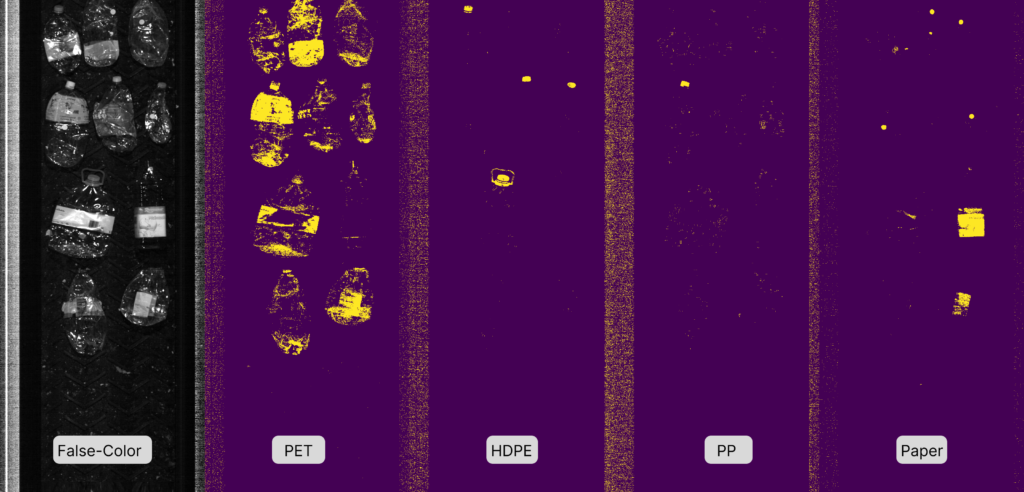
Document contamination logic, class definitions, and shift-specific quality checks so line decisions stay consistent and reviewable.
Standardize stress detection, masking, and reporting logic across regions, data sources, and recurring monitoring workflows.
Scope a Clarity AI workflow for your team
Workflow-based AI is how we make hyperspectral analysis more repeatable, inspectable, and team-ready across earth observation and industrial use cases.
Share the workflow you want to evaluate and our team will follow up with the right next step.