How AI Workflows Make Hyperspectral Analysis Repeatable
Hyperspectral teams do not just need faster answers. They need a way to preserve analyst judgment, encode review logic, and apply the right process consistently across scenes, sensors, and operators. That is where workflow-based AI changes the equation.
Metaspectral Team
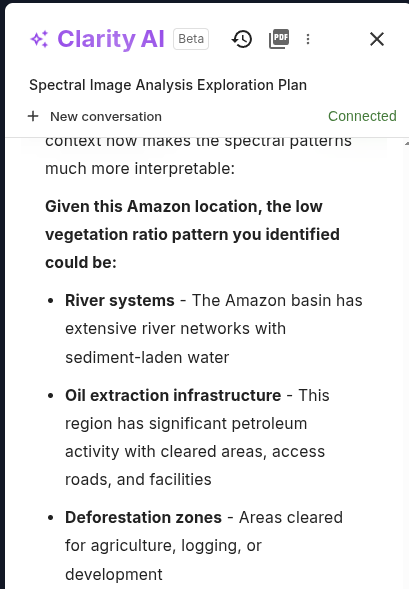
Hyperspectral analysis is rarely blocked by raw data alone. The harder problem is operational: how do you make expert judgment repeatable?
Most teams already have a process, even if it lives in scattered notebooks, scripts, analyst habits, and verbal handoffs. They know which masks to apply first. They know which spectral features matter for the task. They know where false positives usually appear, and they know which checks need to happen before an output can be trusted.
The issue is that this process is often hard to reuse consistently, especially across new hires, new datasets, or new operational contexts. That is where workflow-based AI becomes useful.
A workflow is more than a prompt
The phrase "AI workflow" can sound abstract, but in practice it is very concrete. A workflow is the structured way a team wants analysis to happen. It includes:
- the objective
- the relevant data and sensor context
- the quality standards that matter
- the decision rules used in review
- the conditions where a method should, or should not, be applied
In other words, a workflow teaches the system how your team works, not just what question was asked.
This matters because generic prompting breaks down quickly in technical environments. A broad request like "find targets" or "label the image" is not enough on its own. The answer depends on the sensor, the material system, the masking logic, the confidence thresholds, the reporting standard, and the operational decision attached to the result.
Without that context, AI tends to be fluent but shallow. With a workflow, AI becomes much closer to an operational tool.
"Generic AI gives you language. Workflow-based AI gives you repeatable process.
Why workflow-based AI works better for hyperspectral teams
There are three reasons workflows matter so much in spectral analysis.
1. They capture decision logic
Expert teams do not only look for positive signals. They also know how to interpret ambiguity.
For example, a feature may be present but weak. A threshold may be technically crossed, but only in a noisy region. A material signature may appear valid unless moisture interference is distorting the signal. These are not edge notes. They are the core of expert reasoning.
When workflow logic is encoded, the system can apply those rules consistently instead of forcing every analyst to reconstruct them from scratch.
2. They preserve negative knowledge
A large part of good analysis is knowing what not to trust.
Teams learn, often the hard way, where a map can be misleading, which artifacts resemble real detections, and which preprocessing shortcuts create downstream errors. That negative knowledge is extremely valuable, but it is also easy to lose if it lives only in the heads of senior staff.
Workflow-based AI gives teams a place to preserve those lessons as part of the technology itself.
3. They enforce context boundaries
Good workflows know when they apply and when they do not.
A method built for one spectral range, one target class, or one operating environment should not silently migrate into the wrong use case. A mineral mapping procedure for a SWIR-rich dataset is not automatically valid for VNIR-only imagery. A plume review process designed for one monitoring workflow may not transfer directly to another.
This kind of context awareness is one of the biggest differences between a reusable operational system and a one-off demo.
The compounding effect
The value of workflows is not just that one analysis runs more smoothly. It is that each run can improve the next one.
When a team learns something new, that lesson can update the workflow instead of staying isolated in a private file or analyst memory. Over time, workflows become a living record of what the organization has learned about a task.
This creates a compounding effect:
- new analysts ramp faster
- outputs become more consistent across teams and shifts
- workflows can reference other workflows for multi-step analysis
- review and reporting become easier to standardize
That is a very different model from traditional expert dependence, where quality is concentrated in a handful of people and difficult to scale.
What this looks like in practice
Workflow-based AI can support a wide range of hyperspectral tasks, but the operating pattern stays the same.
In mining, workflows can encode alteration mapping, target ranking, and validation logic so new scenes and new evidence strengthen the process instead of restarting it.
In recycling, workflows can preserve class definitions, contamination logic, and review thresholds so line decisions remain more consistent across vendors, shifts, and facilities.
In agriculture and environmental monitoring, workflows can standardize masking, change detection, confidence review, and reporting logic across recurring monitoring programs.
The key point is not that AI replaces domain experts. It is that AI can help operationalize their reasoning.
From analysis assistant to operational layer
The most useful future for AI in hyperspectral work is not a generic chatbot bolted onto a technical stack. It is a system that can translate requests into structured workflows, execute them with context, and explain what happened in a way teams can actually review.
That is what makes workflow-based AI compelling as a technology direction. It closes the gap between experimentation and repeatable operations.
For teams working with high-dimensional imagery, that gap has always been the hard part.
Explore the workflow-based side of Clarity on our AI Workflows technology page, or request early access through the Clarity AI waitlist.
Talk to Metaspectral about your use case.
Bring us your material stream, imagery, or operational question and we will help scope the next evaluation.
Related Resources
More product thinking and reference material from the Metaspectral team.
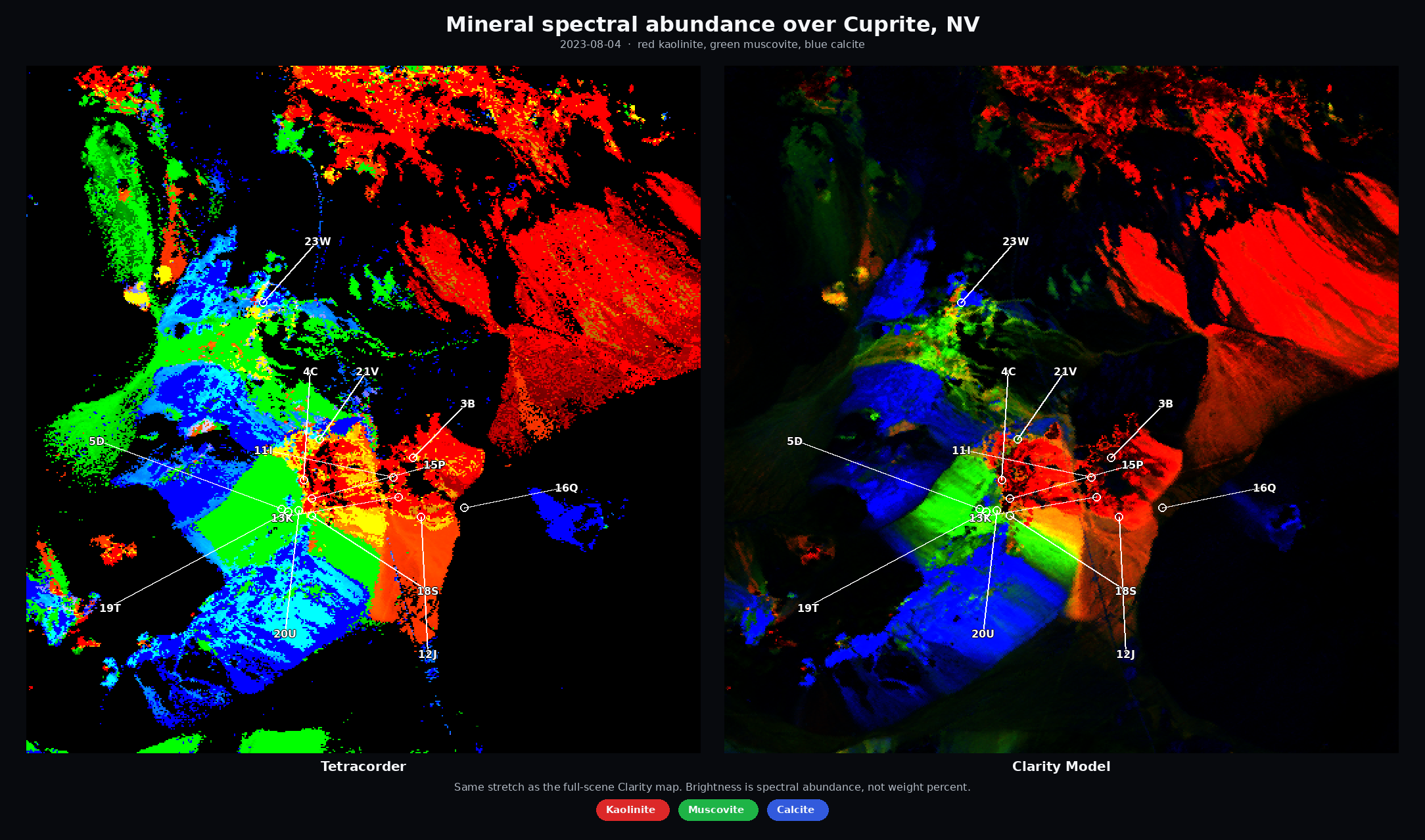
From Spectral Libraries to Cuprite — Better, Faster Alteration Maps
Exploration teams looking for copper, gold, and critical-mineral deposits use hyperspectral imagery to map exposed alteration and indicator minerals—clays, micas, iron oxides, carbonates, and related assemblages.
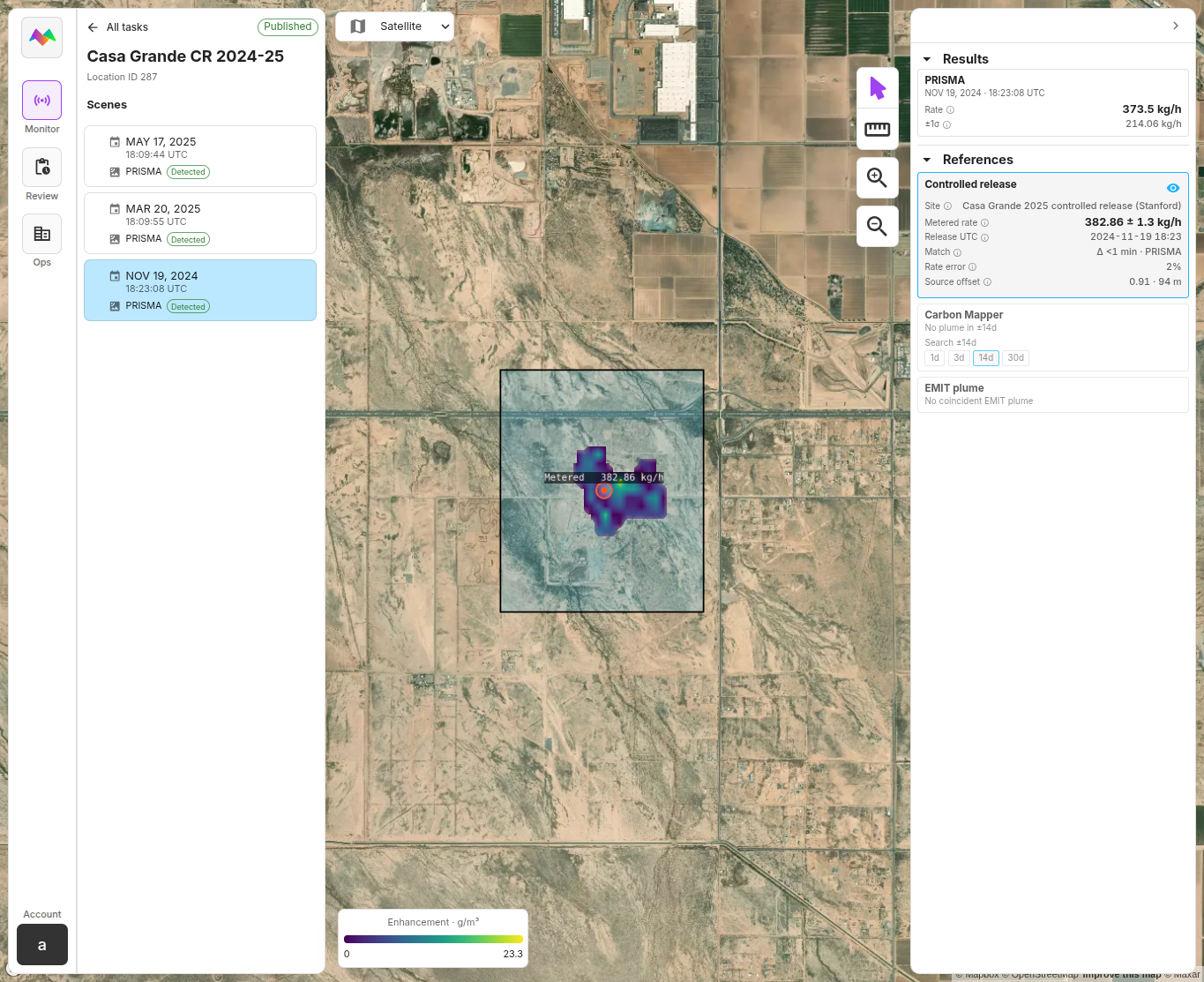
Clarity Plume™ Matches Metered Methane — Review It Faster, on Your Site
A controlled-release evaluation of Clarity Plume's production methane retrievals against PRISMA and EMIT, with metered releases, no-release periods, and review references beside the result.
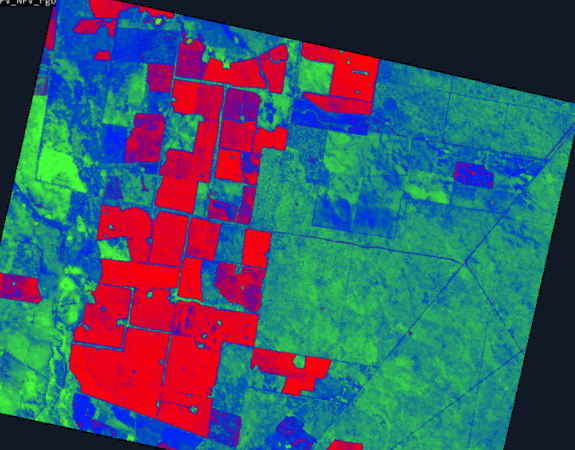
Seeing beyond the bands
Where hyperspectral analysis diverges from multispectral — and what that divergence reveals about a crop. Measured on real scenes.